.svg)
A new asset classification framework to evaluate and understand tokenized assets.
.jpg)
When we first set out to build our analytics platform, the tokenized asset landscape was still narrow enough that a handful of asset class categories could capture everything onchain.
One of the earliest categories was tokenized credit. DeFi protocols like Maple pooled stablecoins and underwrote uncollateralized loans to offchain borrowers. Centrifuge and MakerDAO (now Sky) tokenized offchain collateral (invoices and trade receivables) to support onchain lending. Figure Technologies originated HELOCs using blockchain as the ledger of record to speed up securitization and lower servicing costs. We dedicated a Private Credit page to group these assets.
Another early category was institutional funds. Crypto-native venture funds began representing their portfolio interests on public blockchains by 2018, and traditional alternative asset managers followed. KKR was the first major firm to move, partnering with Securitize in September 2022 to tokenize a portion of its Healthcare Strategic Growth Fund II on Avalanche. Hamilton Lane soon joined in with a similar structure, along with other managers. We created an Institutional Alternative Funds page to classify these assets.
As tokenization accelerated through 2023, we expanded our classification to accommodate the products coming to market: U.S. Treasuries, Commodities, Stocks, Non-U.S. Government Debt, Corporate Bonds, and Real Estate.
While each addition made sense in isolation, two issues emerged as more institutions launched their products onchain.
First, the term private credit was applied to any non-sovereign debt regardless of borrower type, collateral, or structure. For example, corporate credit, the source of recent turmoil in sponsor-backed lending, was being lumped together with consumer loans and asset-backed facilities, despite fundamentally different underlying exposure and risk profile. Our Private Credit page had become a catch-all, and these distinctions needed to be made explicit.
Second, the same problem was playing out with institutional funds. The Institutional Alternative Funds page had become a landing place for any fund products, classifying assets by their wrapper rather than by what they actually held.
Existing classification models in financial markets were built primarily for portfolio construction and benchmarking. They sort instruments by market convention, legal structure, or origination channel, rather than by the risk investors are actually taking. While a collateralized loan obligation (CLO) is ultimately a pool of loans to corporate borrowers, major classification frameworks, including Bloomberg’s fixed income indices and Morningstar DBRS’s rating methodology, classify them as structured products alongside mortgage-backed securities and other structured credit. The wrapper defines the category, not the underlying exposure.
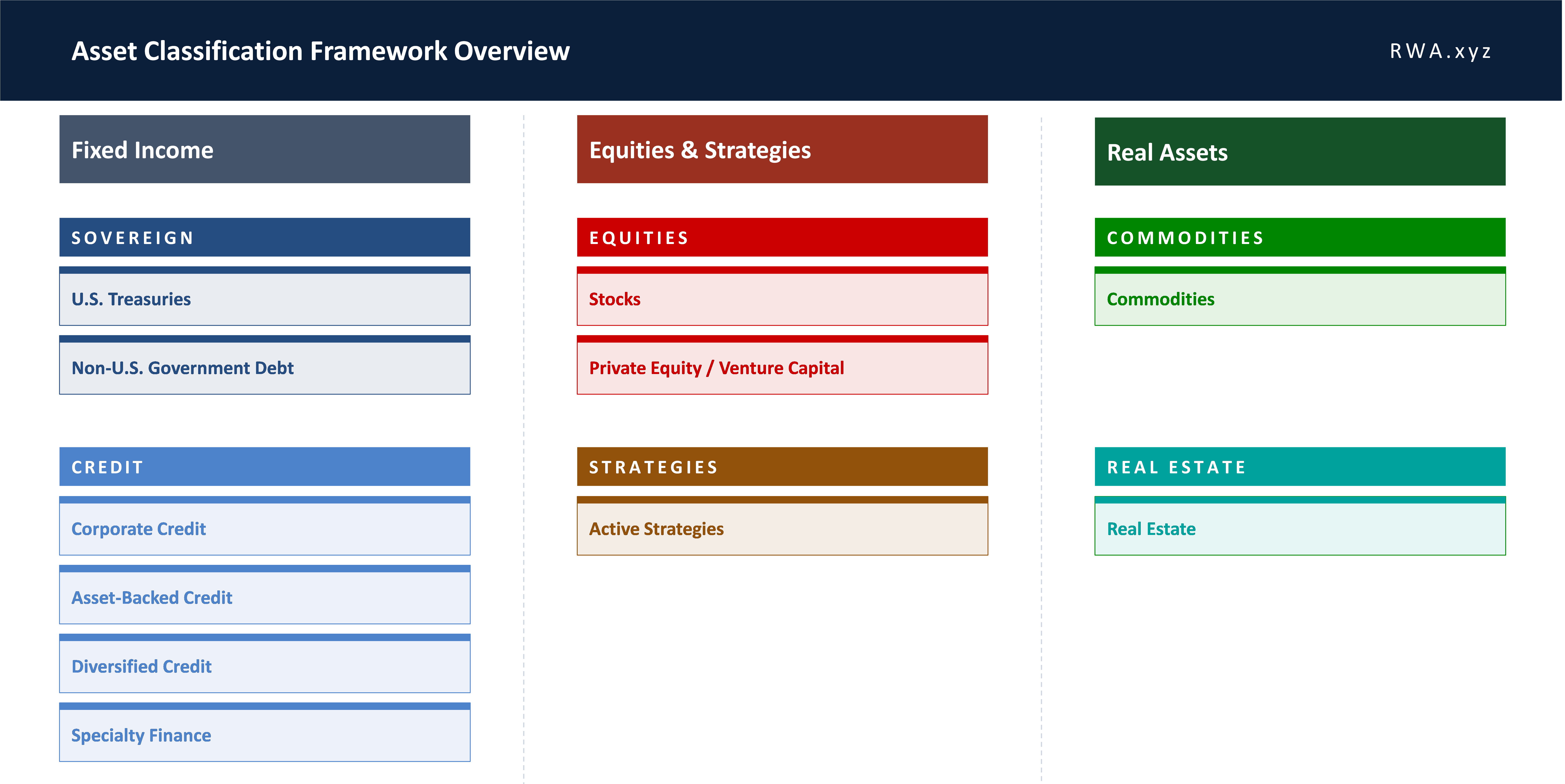
We took a different approach. Rather than adopting an existing taxonomy, we built our own classification framework around economic exposure, because that is what determines the underwriting framework and remains stable even as assets are tokenized and distributed through new channels. A structured product backed by corporate loans presents a different risk profile from one backed by consumer receivables or asset-backed claims, even if both sit in the same legal wrapper.
The changes below follow that premise.
The full classification framework and descriptions are provided below.
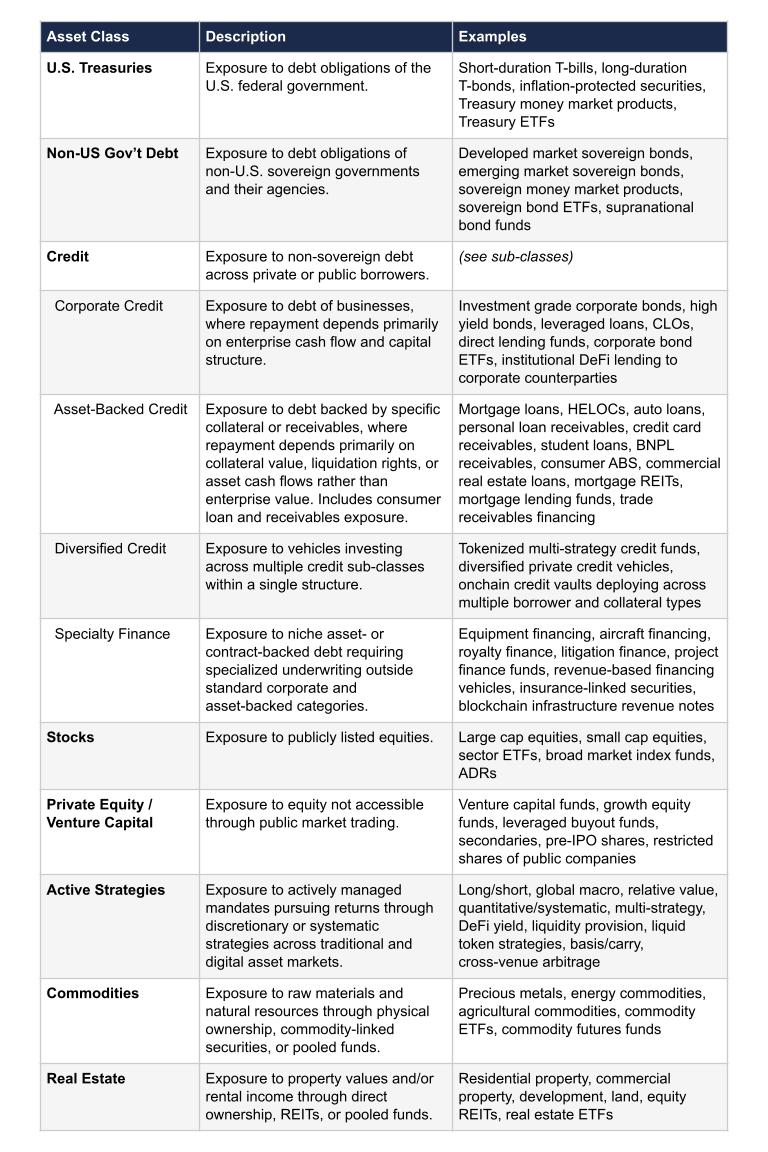
We plan to add additional dimensions as metadata on top of new framework, enabling more granular filtering and analysis without altering the underlying classification logic.
These fields will capture how a tokenized asset is technically structured and held onchain, as well as whether it is originated directly by the issuing entity or sourced through a third-party manager or intermediary. For credit assets, we are also considering dimensions such as collateralization and seniority, reflecting the variables that matter most in fixed income analysis.
By keeping these dimensions separate from the primary taxonomy, they can function as queryable attributes alongside asset class designation, allowing institutional users to filter and analyze across the combinations most relevant to their diligence process.
A shared classification framework does more than just organize a dataset. It creates a standard, a precise and consistent basis on which every tokenized asset can be evaluated, compared, and understood. Without that standard, financial institutions and crypto-native participants will continue speaking two different languages, which slows down progress and adoption.
Getting to the next phase of tokenization requires the kind of transparency and analytical discipline that financial institutions are used to in traditional markets. A classification standard is the foundation that makes that possible.
RWA.xyz remains committed to refining this framework over time, because we believe the ability to classify and contextualize tokenized assets will matter just as much as the infrastructure that is used to issue them.
We welcome your feedback at team@rwa.xyz.