.svg)
A comprehensive playbook for institutional asset managers exploring allocation vaults as a distribution strategy.
.jpg)
Allocation vaults are emerging as the primary distribution infrastructure for tokenized assets seeking to reach onchain capital. This primer explains what they are, how they work, and what institutional asset managers need to know to evaluate the opportunity.
Despite heightened interest around allocation vaults, it’s hard to find a comprehensive resource prepared for non-crypto institutional asset managers. That's what inspired this primer. As tokenized assets approach a distribution inflection point, we at RWA.xyz wanted to create a strategic playbook for institutional asset managers that is both informative and easy to read.
Institutional tokenized assets are following a three-phase evolutionary arc. Each phase solved the previous phase's limitation and each created the foundation for the next.

A handful of crypto-native venture funds began representing tokenized interests of their portfolios on public blockchains as early as 2018. But, the first major alternative asset manager to tokenize a fund was KKR, which partnered with Securitize in September 2022 to tokenize a portion of its Healthcare Strategic Growth Fund II on Avalanche. Hamilton Lane followed shortly after through the same feeder fund structure.
The initial thesis was operational efficiency. Tokenized feeder funds reduced administrative overhead and lowered minimum investment thresholds, opening access to a broader investor base. The expectation was that lowering barriers to entry would eventually drive demand for these fund products.
In practice, democratizing access didn’t move the needle. The real demand came from where it was least expected. And to understand why, we need to understand how yields are set onchain.
Most DeFi lending protocols follow a simple model: lenders deposit stablecoins, borrowers post crypto assets as collateral to borrow against them, typically to leverage long positions. Because crypto markets carry a long bias, DeFi lending rates have frequently exceeded U.S. Treasury yields.
That changed when the Fed hiked the federal funds rate from 0.25% to 5.5% by July 2023. With the crypto bear market depressing borrowing demand, stablecoin yields fell to around 3% and onchain capital began gravitating toward tokenized Treasury products. The product-market fit was immediate, and tokenized Treasuries now represent over $10 billion as of February 2026.
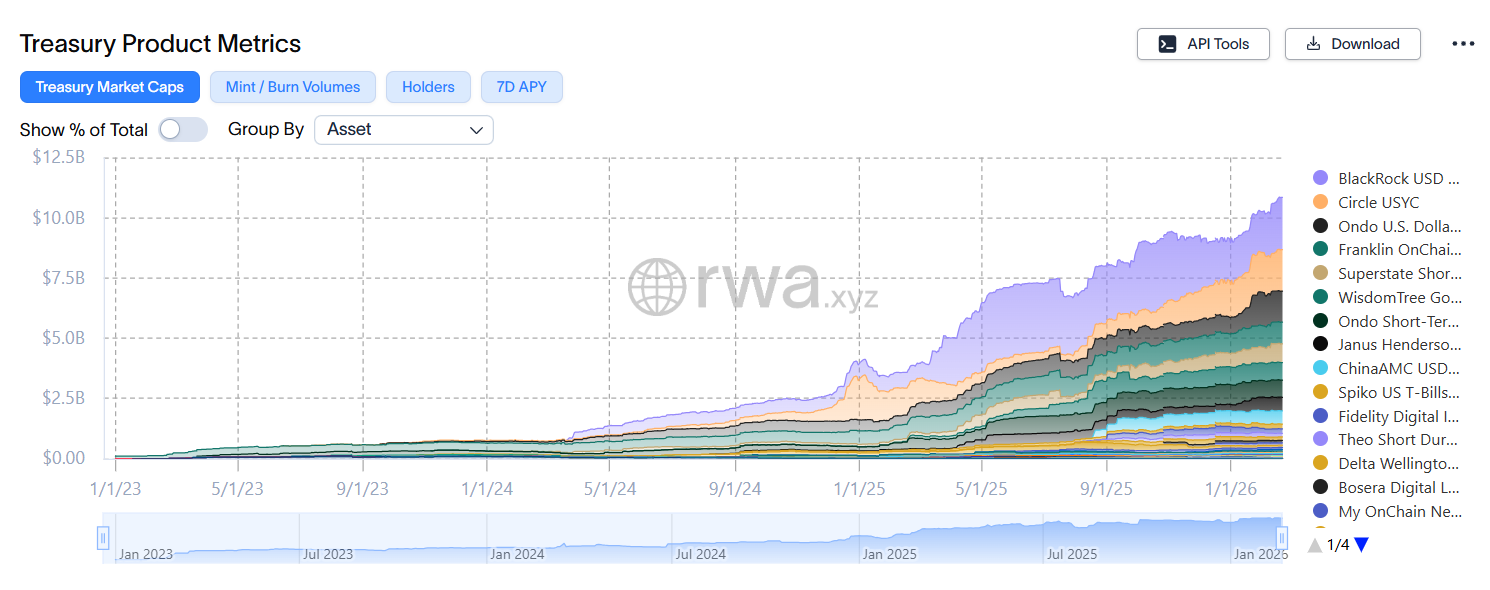
Source: RWA.xyz (as of 2/22/26)
Through tokenized Treasuries, institutional asset managers discovered that blockchain networks are not just a platform for improving operational efficiencies. They are a new distribution channel that taps into a pool of capital already living onchain. As the crypto bull market returned and onchain investors grew more comfortable with tokenized products, demand naturally extended toward higher-yielding tokenized private credit products.
Unlike Treasury products, however, private credit had structural issues that created a fundamental mismatch with DeFi. Institutional asset managers quickly learned that tokenizing higher yielding products does not automatically create onchain demand. The products had to be restructured and integrated with the right DeFi infrastructure.
That's where allocation vaults enter the picture. They address the distribution problem by integrating tokenized credit products into DeFi lending markets as collateral, something a standalone tokenized fund cannot solve.
“Vault” is one of the most overused terms in crypto. At a high level, it generally means “a smart contract that holds assets.” In practice, that label can be applied to everything from a passive wrapper to an automated strategy contract to a credit pool.
For institutional readers, a vault is simply an onchain equivalent of an investment vehicle that provides exposure to a defined strategy. Investors deposit an asset, often stablecoins, and receive receipt tokens that represent a pro-rata claim on the pool, similar to fund units.
The key difference is governance and enforcement. Traditional vehicles are governed through legal documents and manager discretion, with rules enforced through contractual and regulatory frameworks. Vaults are governed by parameters encoded in smart contracts and enforced programmatically.
Given that the tokenized asset industry is maturing and increasingly serving institutional audiences, we think it’s prudent to use a more specific terminology. In this primer, we focus on a particular class of vault: the allocation vault.
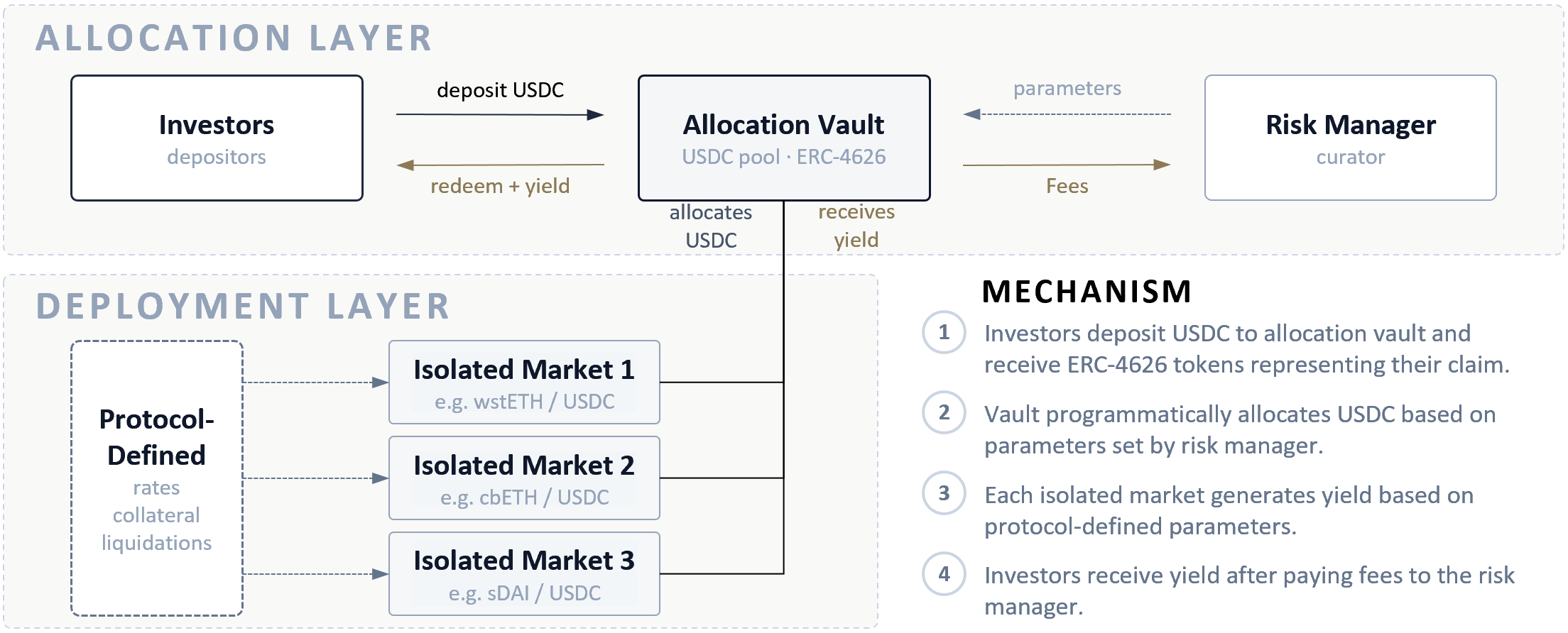
An allocation vault is a smart-contract allocation machine built on top of a lending protocol. A risk manager (often called a “curator” on DeFi platforms) sets the strategy and parameters for how deposited assets are deployed across isolated lending markets.
Note: Allocation vault implementations vary across protocols. In this primer we primarily reference Morpho’s structure, but the underlying concepts are generally similar albeit with different terminologies.
Figure 1: Allocation Vault Architecture & Yield Distribution
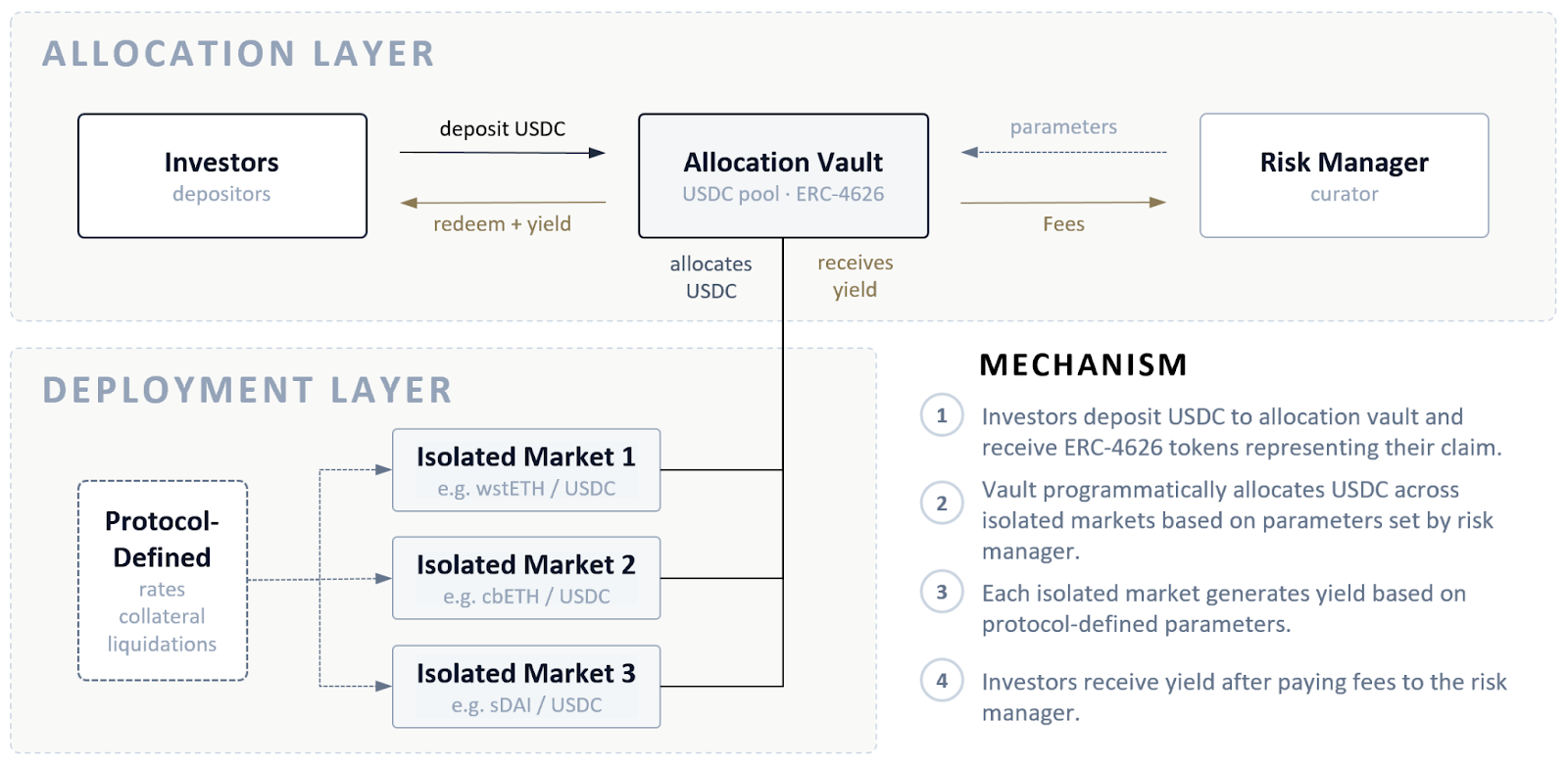
An allocation vault is best explained as a two-layer system. At the bottom sits the deployment layer where returns are generated. The protocol defines how interest accrues, what collateral is eligible, and how liquidations occur for each isolated market.
On top sits the allocation layer, where risk managers set the parameters. The vault accepts a single loan asset, typically USDC, and deploys it across multiple isolated markets on the deployment layer.
A more useful framing for institutional readers is a direct comparison between a traditional fund structure and an allocation vault. The table below maps each role and highlights how enforcement mechanisms differ.
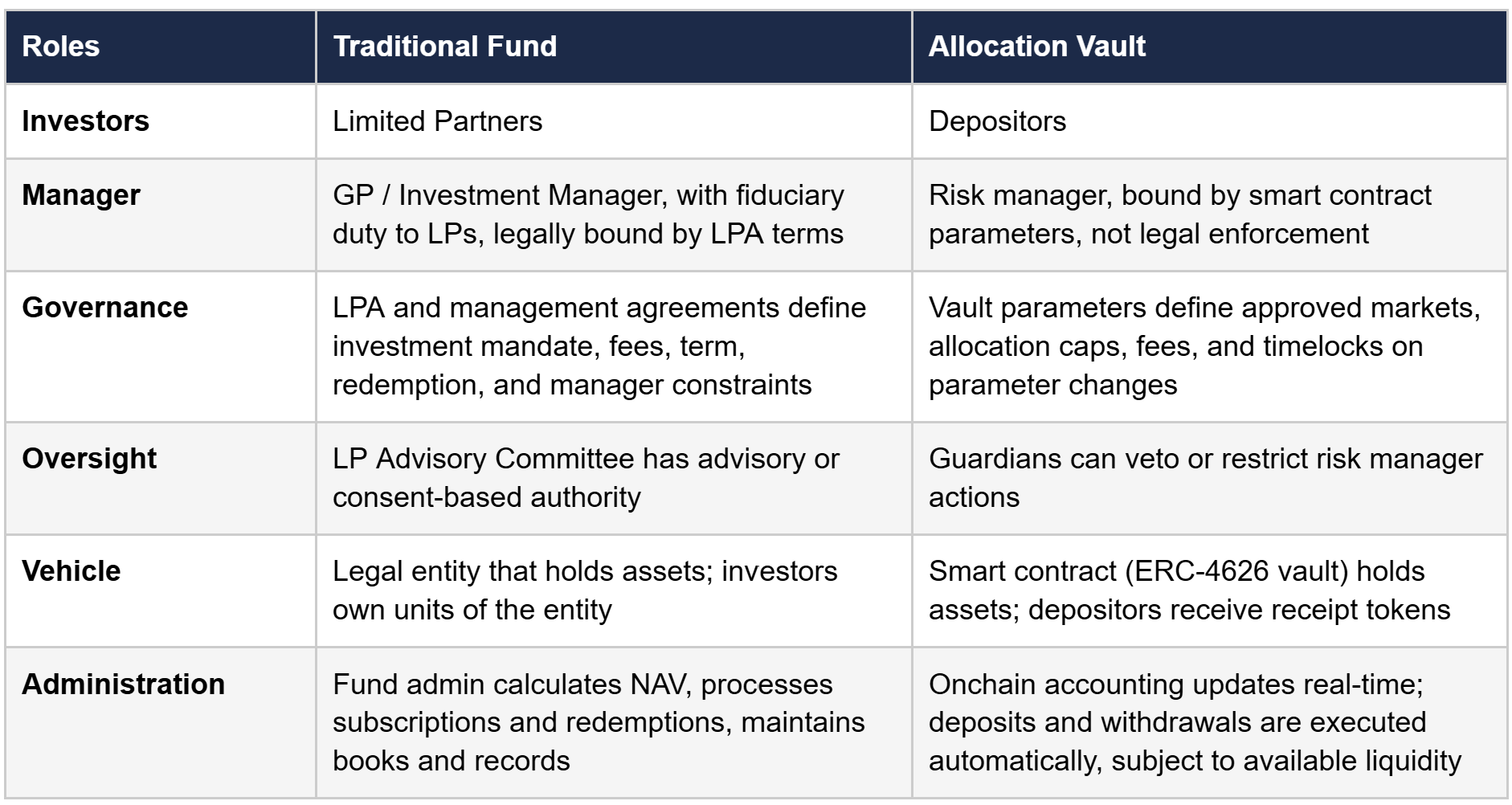
The most important takeaway from this comparison is that allocation vaults represent a fundamentally different trust model. Blockchains translate parts of legal and contractual reality into software, shifting from rules enforced by courts to rules executed by code. The risk manager is not bound by fiduciary duties or legal documentation, but rather by what the smart contract permits. Enforcement is ex ante rather than ex post: out-of-policy actions simply fail to execute.
This section describes the journey of a tokenized product from origination to distribution. Under this construct, the risk manager functions more like a prime broker’s collateral desk.
Traditional fund products move through a well-defined value chain. A manager runs the strategy, a structurer packages it, a prime broker provides leverage, a margin desk decides the collateral terms, and a wealth platform distributes it to end investors.
The onchain equivalent follows a similar sequence. The difference is that blockchains compress settlement, automate enforcement, and interconnect with platforms to distribute the products.
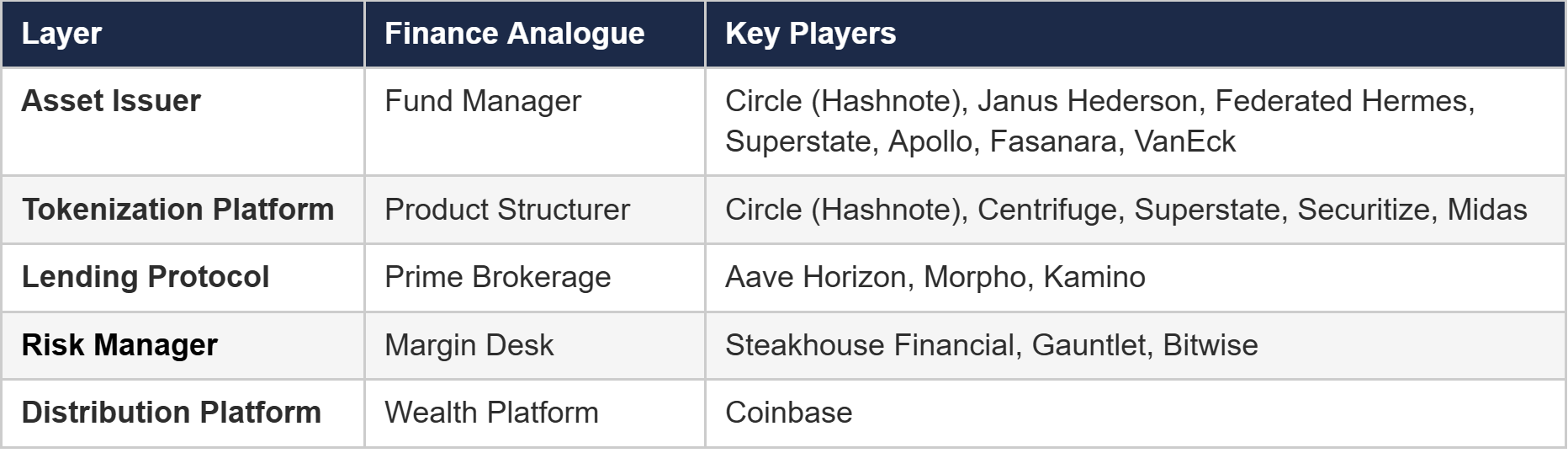
This is where the journey begins. The fund manager creates the investment strategy, originates the asset, and manages the portfolio.
In traditional markets, distribution and financing are relationship-driven. Investors subscribe directly, and leverage (if available) requires a prime broker to accept the position as eligible collateral on negotiated terms. For many private assets, this process is bespoke, slow, and limited to investors with the right counterparties and balance sheet access.
In onchain markets, the issuer’s job stays the same: run the strategy. The difference is downstream. Once the exposure is tokenized, it can be evaluated as collateral, financed in lending markets, and distributed through onchain channels without the issuer building bespoke infrastructure for each counterparty.
The list of fund managers whose tokenized products are actively integrated into onchain markets is available in Exhibit A.
When a fund needs to reach investors through a specific channel, a product structurer packages it into the appropriate wrapper. An investment bank might take an equity product and structure it as an ETF or a structured note. A credit product might be packed as a CLO or a credit-linked note. The structurer does not run the strategy, but they make it distributable.
Tokenization platforms perform the same function. They take the fund manager’s strategy and package it into a token, an onchain instrument that conforms to standards the rest of the stack can read. The key difference from legacy wrappers is composability. Once tokenized, the asset can be integrated into DeFi protocols to be used as collateral, allocated programmatically, and embedded into portfolio and yield products available for end consumers.
The list of platforms that are actively integrated into tokenized DeFi markets is available in Exhibit B.
Prime brokerage consists of two things: the platform that executes financing and liquidations, and the risk function that decides what collateral is accepted on what terms.
Onchain lending protocols provide the platform side. They are automated systems that execute lending, borrowing, interest accrual, and liquidations based on pre-defined parameters. The protocols are generally asset-agnostic: they simply enforce rules and do not enforce underwriting judgment.
Protocols rely on an oracle, the onchain equivalent of a pricing agent, that sources the value of the underlying assets and publishes the feeds onchain. This information is used to set the loan-to-value and execute liquidations automatically.
The three lending protocols most active in tokenized asset markets are Aave Horizon, Morpho, and Kamino. Detailed profiles of each protocol are available in Exhibit C.
While lending protocols serve as the primary example of this deployment layer in the primer, the architecture is not limited to lending. Any smart contract-driven vault, including yield aggregators, structured products, liquidity strategies, or other onchain investment vehicles, can be paired with an allocation vault.
Within a prime broker, the margin desk evaluates the eligibility of the collateral, sets the haircut and concentration limits, and adjusts terms as market conditions change.
Risk Managers perform the same function onchain. They approve which tokenized assets can be used as collateral in their vaults, set risk parameters, and allocate stablecoin liquidity across the markets they underwrite. Protocols enforce and risk managers underwrite. If an asset isn’t underwritten by a risk manager with meaningful liquidity behind them, it may be tokenized, but not financeable at scale.
The leading risk managers like Steakhouse Financial and Gauntlet operate across multiple lending protocols. Bitwise became the first major traditional asset manager to launch an allocation vault on Morpho in January 2026, signaling the institutional crossover has begun. Detailed profiles of each risk manager are available in Exhibit D.
Unlike Morpho and Kamino, Aave Horizon does not operate through a separate allocation layer. Eligible collateral, risk parameters, and allocation rules are defined at the protocol level by Aave Labs in coordination with risk managers like Llama Risk, making the protocol itself the risk function rather than delegating that role to independent risk managers.
The degree to which risk managers operate within programmatic constraints also varies by platform type. On public, open platforms like Morpho and Kamino, parameter changes are subject to timelocks and governance veto rights, ensuring no single party can unilaterally alter vault behavior. Private or enterprise deployments, by contrast, can be structured as permissioned systems where parameters are adjustable by agreement between the deploying institution and its counterparties.
Beyond the lending-native platforms, there are also vault infrastructure providers like Veda that manage significant capital across DeFi yield strategies. Their existing products are oriented toward crypto-native assets, but many are actively exploring integrations with tokenized assets and therefore could be an important channel for institutional asset managers in the near future.
Every financing market needs a funding base. In traditional markets, the cash that finances margin loans and repo comes from aggregated pools: money market funds, bank treasuries, institutional cash management, and wealth platforms that intermediate retail and institutional deposits. End investors simply see a yield, not the collateral chain underneath.
Onchain distribution platforms play the same role by aggregating stablecoin deposits and routing them into allocation vaults. Coinbase is the clearest example. Its USDC lending product routes deposits through Steakhouse allocated Morpho vaults on Base. The platform and vault infrastructure are abstracted away and the end users simply see a yield product.
Many allocation vaults attract direct deposits, but integration with a distribution platform is a key scaling mechanism. In traditional asset management, distribution is the hardest and most expensive problem. It requires placement agents, sales teams, investor relations, and often years of relationship building before a product reaches meaningful scale.
In the allocation vault model, distribution can be embedded into the rails themselves. Once an asset is accepted as collateral in a widely used allocation vault, it is much easier to integrate with various distribution platforms.
This dynamic applies to Morpho and Kamino, but Aave is different: it’s vertically integrated and can act as its own distribution channel. Major wallets like MetaMask and Bitget have integrated Aave directly to power stablecoin yield products. And in November 2025, Aave launched a consumer savings app on the Apple App Store that runs on top of its lending protocol, targeting retail savers with no prior onchain experience. Aave controls both the infrastructure and the distribution, while Morpho and Kamino are composable infrastructure that others build on, without any single entity owning the full stack.
In 2025, Fasanara Capital, a London-based FCA-regulated private credit manager with $5B+ in AUM, partnered with Midas, a German-incorporated tokenization platform, to bring its flagship F-ONE strategy onchain as mF-ONE. The product launched on Morpho with Steakhouse Financial as risk manager and scaled rapidly, reaching over $160M within months, making it one of the largest tokenized collateral markets on the protocol.
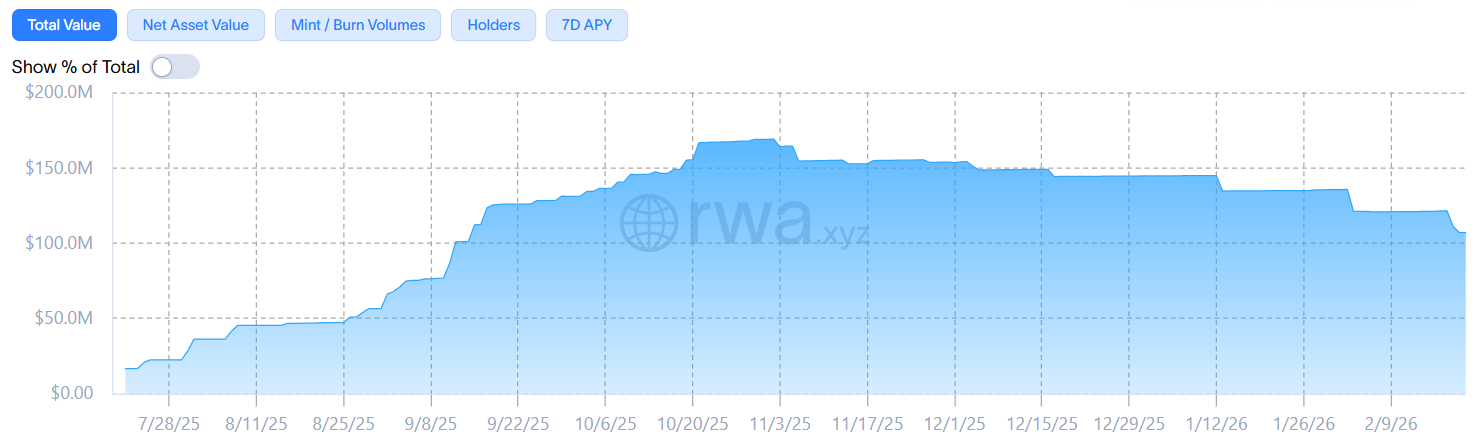
Source: mF-ONE total value over time from RWA.xyz (as of 2/22/26)
mF-ONE is a useful case study because it shows what a “successful tokenization” actually requires. Putting a fund onchain is not, by itself, sufficient to unlock new capital. A tokenized product may exist, but still unusable across onchain capital markets. mF-ONE scaled because it was designed to be financeable, liquidatable, and distributable inside DeFi rails.
Tokenized Treasuries naturally worked onchain because the underlying instruments are liquid and settle quickly. Private credit is different. Fasanara’s F-ONE fund operates on traditional liquidity terms: monthly subscriptions and quarterly redemptions.
That creates a direct mismatch with onchain lending markets:
Legal structuring for composability
mF-ONE does not represent direct ownership of F-ONE fund shares. Instead, it is structured as a bearer bond certificate issued by Midas, providing contractual beneficiary rights to the performance of F-ONE exposure through a bankruptcy-remote structure.
Practically, this does two things that matter for DeFi markets:
Liquidity engineering as a core product feature
Even with a composable instrument, the collateral still needs a credible liquidity profile. mF-ONE addresses this with a three-layer capital stack that builds progressively faster liquidity into the product.
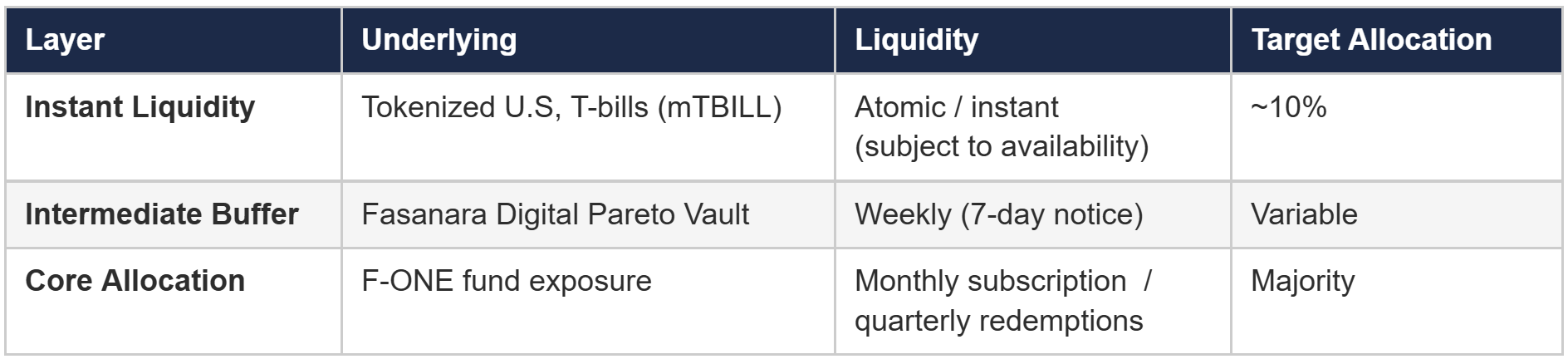
The instant-liquidity sleeve is the key innovation. Targeting approximately 10% of AUM, it allows holders to redeem mF-ONE for USDC instantly (subject to available liquidity), with a redemption fee that compensates remaining holders for cash drag. In effect, it converts a quarterly redeemable credit fund into an instrument that can function inside real-time settlement markets.
The intermediate buffer solves a second, practical timing issue: newly subscribed capital that will otherwise sit idle until the next subscription window. The buffer keeps capital productive while preserving a faster liquidity profile than the core fund exposure.
Figure 2: Simplified mF-ONE End-to-End Flow Diagram
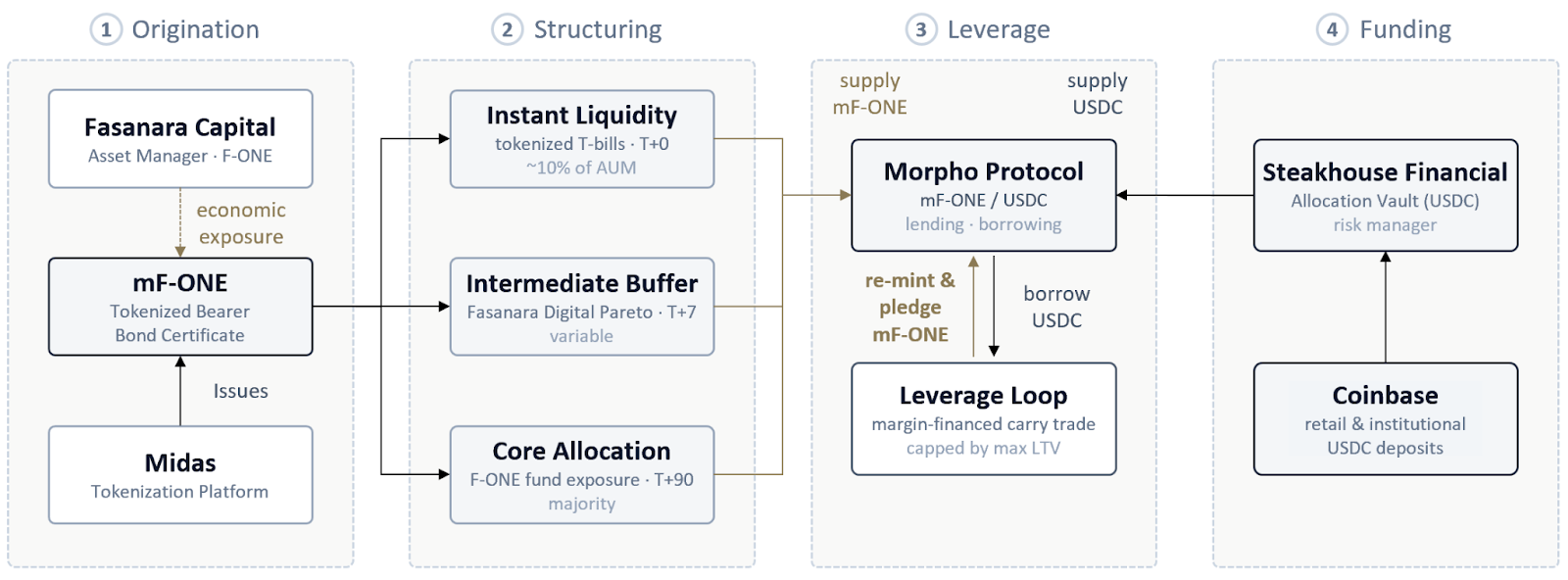
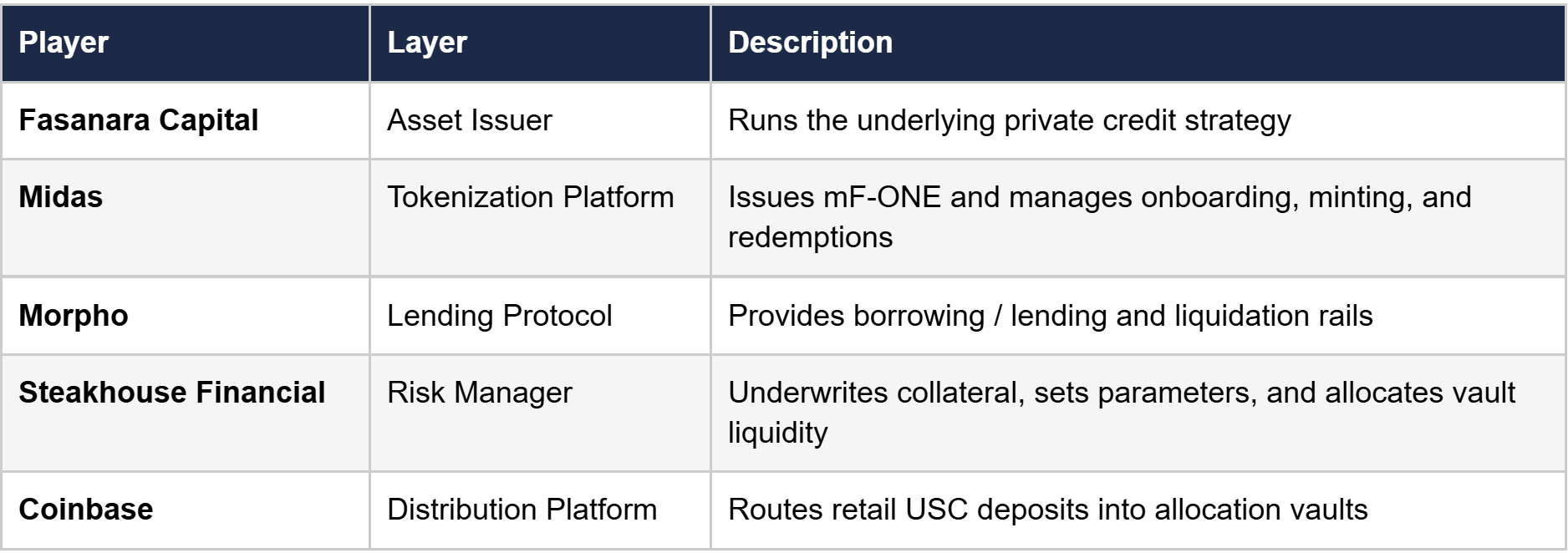
The onchain distribution stack described in the previous section maps directly onto mF-ONE’s distribution strategy.
When a borrower's position in the mF-ONE lending market becomes undercollateralized due to NAV writedown, Morpho’s liquidation mechanism is triggered. Unlike traditional repo, where collateral can often be seized and sold nearly immediately, private credit assets are not inherently "sold-on-demand."
To bridge this gap, Fasanara, Midas, and Steakhouse Financial structured different mechanisms in which liquidators purchase mF-ONE collateral at a meaningful discount to the most recently published NAV, creating enough expected return to compensate for the time and operational steps required to exit.
After acquiring the collateral, a liquidator has three routes to liquidity:
Path 1: Atomic redemption (fastest). A portion of mF-ONE is allocated to a liquidity sleeve invested in tokenized U.S. Treasury bills, which can be redeemed onchain immediately. This path is best suited to smaller positions and routine activity rather than large-scale stress scenarios.
Path 2: Secondary market sale (intermediate). The mF-ONE token can be unwrapped into the underlying private credit note and sold to offchain institutional buyers that are unable to custody tokenized instruments. This expands the buyer base beyond onchain participants. Buyers may then hold the note or redeem it directly with Fasanara through the standard redemption process.
Path 3: Standard fund redemption (slowest, most certain). As a backstop, the liquidator can hold the collateral and submit a standard redemption request to the fund, receiving cash at NAV within 90 days. Because the collateral is acquired at a discount, the expected return over that period remains attractive.
These paths constitute a liquidity waterfall analogous to those in structured credit. The key diligence question is the offchain execution: whether the secondary market and unwrap-to-note sale process is sufficiently deep, operationally robust, and free of conflicts to function under stressed conditions.
The mF-ONE case demonstrates that successful tokenization of a private credit fund requires solving four interconnected problems simultaneously.
Before designing a tokenized product for the allocation vault ecosystem, institutional asset managers should align on a set of strategic, regulatory, and operational questions. This section is not an exhaustive diligence list, but a starting point for early conversations with legal counsel compliance, and product leads.
There are two paths into the allocation vault ecosystem:
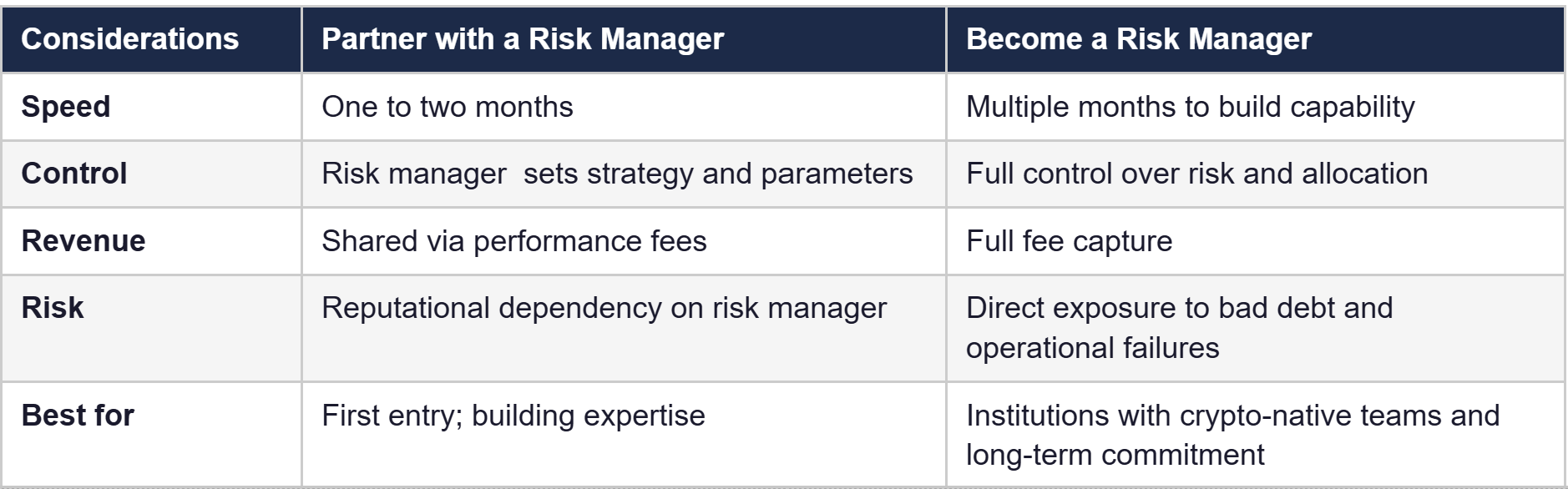
For most institutions, the pragmatic path is to start as a partner to build expertise, then evaluate self-curation later on. This mirrors how traditional asset managers typically enter new markets: seed with an external manager, learn the mechanics, then bring the capability in-house once the strategy is proven.
Securities classification. Vault tokens exhibit investment contract characteristics under the Howey test. Pooled capital, yield expectation, active risk management. Evaluate whether your product triggers securities registration requirements and whether the Investment Company Act or Investment Advisers Act applies to your structure.
KYC/AML and permissioning. Compliance infrastructure for permissionless systems already exists. Evaluate which permissioning model fits your regulatory obligations.
Risk manager liability. No court has tested risk manager fiduciary obligations, but the functional parallels to investment management are strong. Risk managers exercise discretion over allocation, charge fees, and depositors rely on their expertise. Build governance infrastructure ( timelocks, guardian veto mechanisms, transparent reporting, etc.) on the assumption that regulatory frameworks will eventually impose fiduciary-like obligations.
Jurisdiction. Under MiCA, a vault with an identifiable risk manager making management decisions may fall outside the "fully decentralized" exemption and require CASP registration. In the U.S., a risk manager exercising discretionary allocation decisions over pooled capital may trigger investment adviser registration requirements under the Investment Advisers Act.
Oracle and valuation risk. For tokenized asset vaults, the oracle is one of the most critical failure points. A stale or inaccurate price feed can trigger inappropriate liquidations or create bad debt. Understand who controls the feed and what safeguards exist.
Key and upgrade control. Audit the full permissions structure: who holds admin keys, what timelocks protect against unilateral parameter changes, and what is truly immutable versus modifiable.
24/7 operational resilience. There is no market close, and liquidations, oracle updates, and stress events happen around the clock. Evaluate whether your operations team is built for continuous monitoring or whether you need to find a partner.
Smart contract risk. Immutable code means bugs cannot be patched post-deployment. Determine your risk tolerance early.
Accounting and tax treatment for DeFi vault participation remains unsettled. FASB ASU 2023-08 provides fair value measurement guidance for certain crypto assets, and the SAB 121 rescission removed the requirement to record safeguarded crypto assets as balance sheet liabilities.
Beyond these developments, no specific guidance exists for vault share classification or whether depositing into a vault constitutes a taxable exchange. Engage specialized digital asset accounting and tax advisors before deploying capital.
Tokenized assets have reached a distribution inflection point. The question is no longer what can be tokenized, or even how. It is how products can be structured for compatibility with DeFi infrastructure and distributed to onchain investors. RWA.xyz believes allocation vaults will play a central role in shaping this evolution, and that 2026 will mark the acceleration of convergence between traditional finance and DeFi.
The mF-ONE case study demonstrates one proven path, but it won't be the only formula. We expect to see a range of approaches that solve the same fundamental problem: structuring tokenized assets to integrate with existing onchain infrastructure and reach the capital already living there.
As these frameworks mature, the early-mover advantage will compound. Institutions that are building DeFi fluency, risk manager relationships, and distribution track records now are creating moats that will be difficult to replicate when the broader wave arrives. We hope this primer serves as a launching pad for the next generation of institutional asset managers who will explore, and inevitably upgrade our financial infrastructure.
This is not the end of institutional tokenization. It is not even the beginning of the end. But it is, perhaps, the end of the beginning. And RWA.xyz remains committed to working with institutional asset managers to support the vision of a truly open and interoperable financial system.
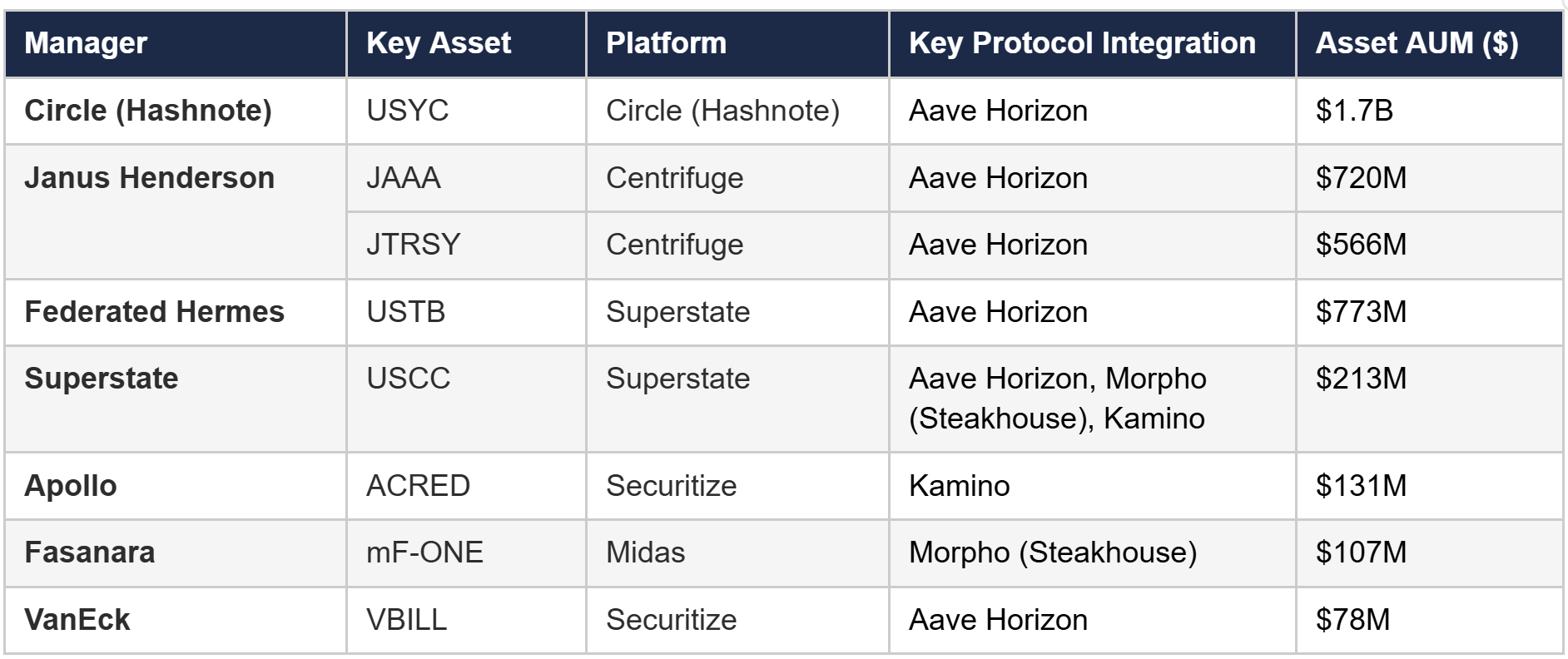
Source: Asset AUM metrics from RWA.xyz (as of 2/22/26)
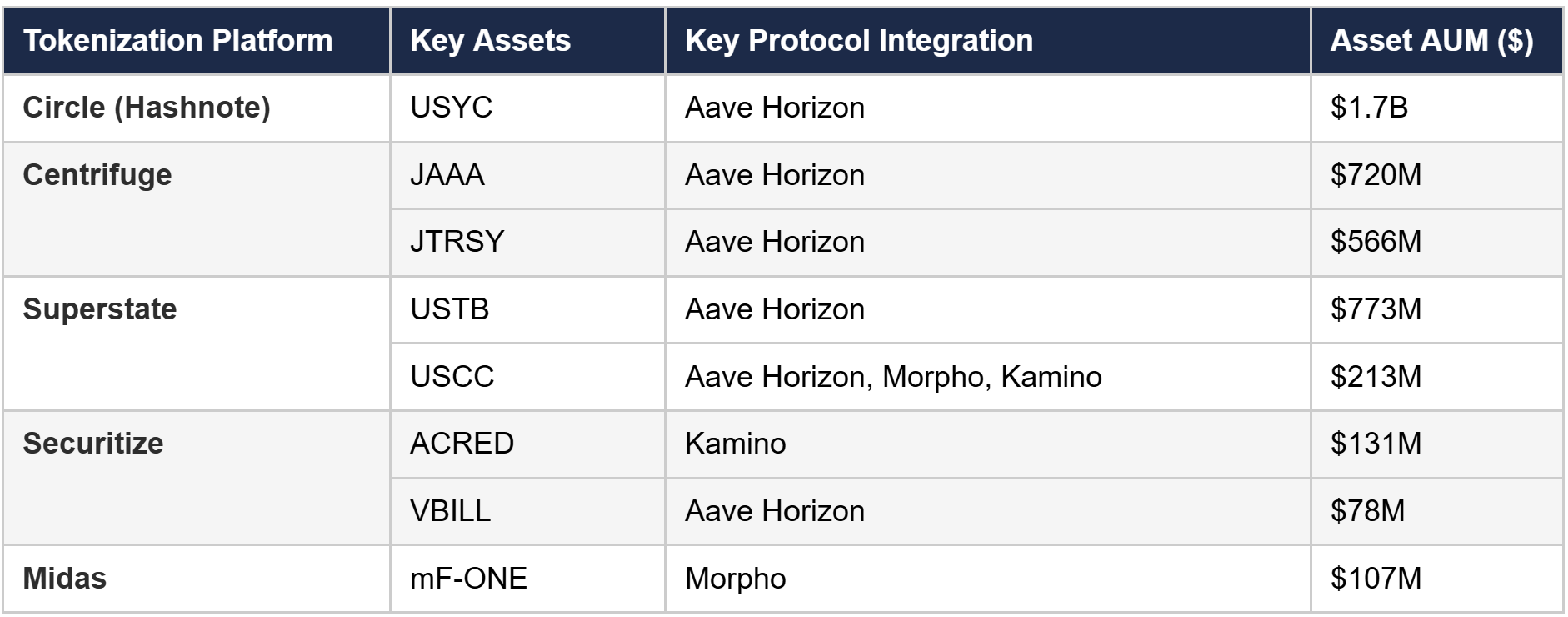
Source: Asset AUM metrics from RWA.xyz (as of 2/22/26)
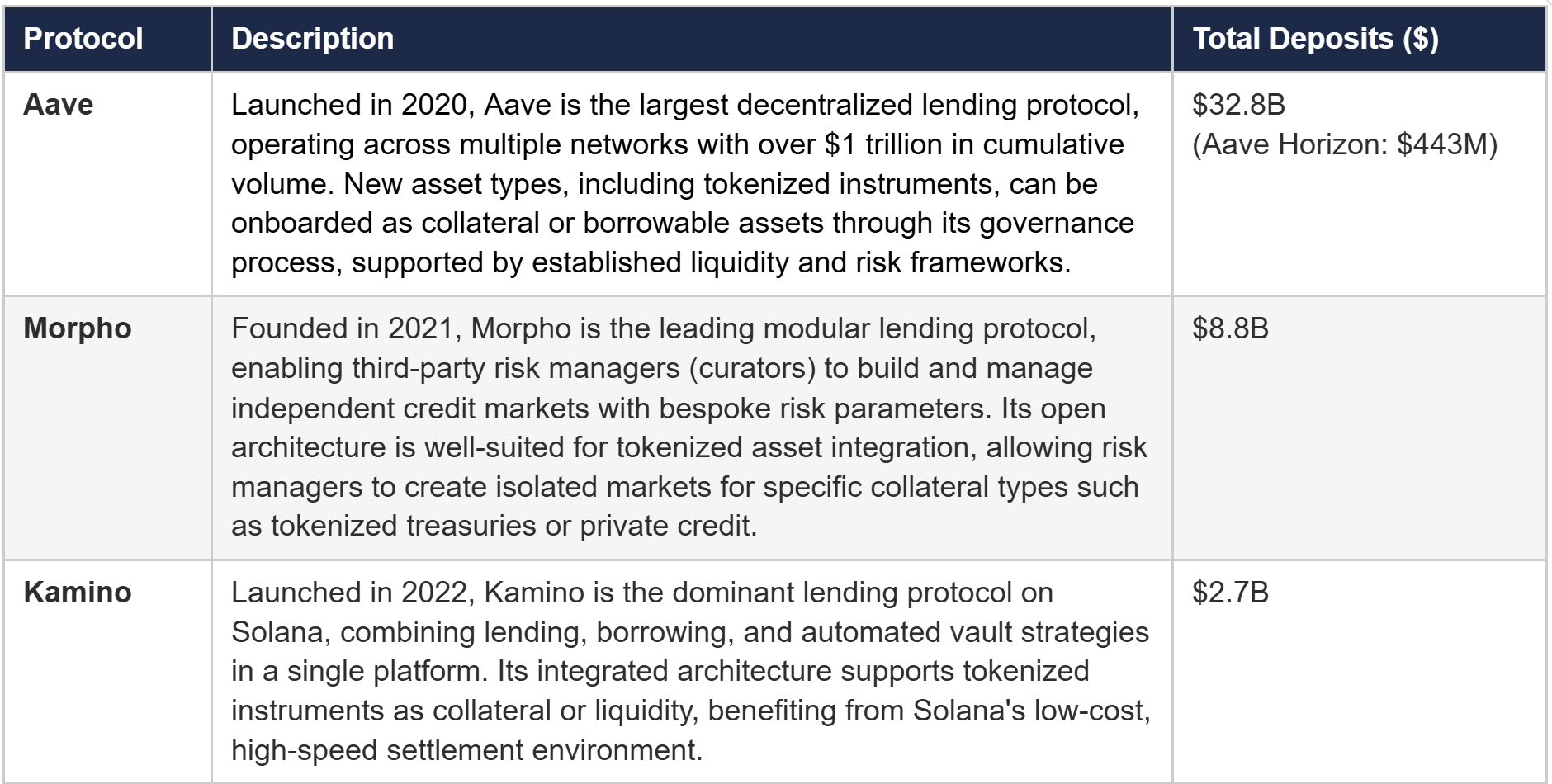
Source: Total platform deposits metrics from each protocol (as of 2/23/26)
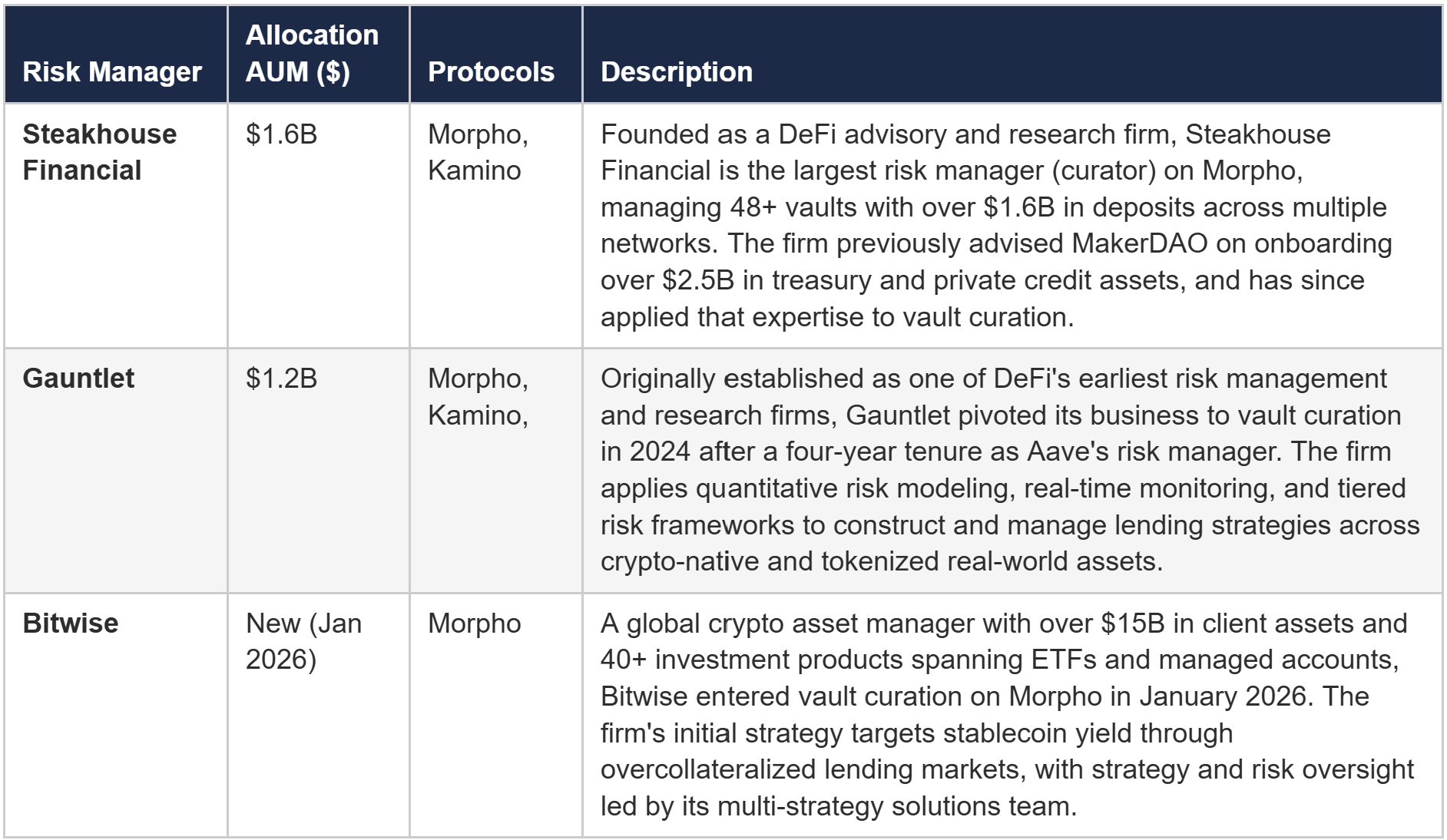
Source: Allocation AUM metrics from each listed protocol (as of 2/23/26)
Disclaimer
This report is prepared by RWA.xyz for educational and informational purposes only. It does not constitute financial, legal, or investment advice. The information herein is based on publicly available materials as of February 2026. Product structures, parameters, and performance may have changed. Readers should conduct their own due diligence and consult qualified advisors before making investment decisions.